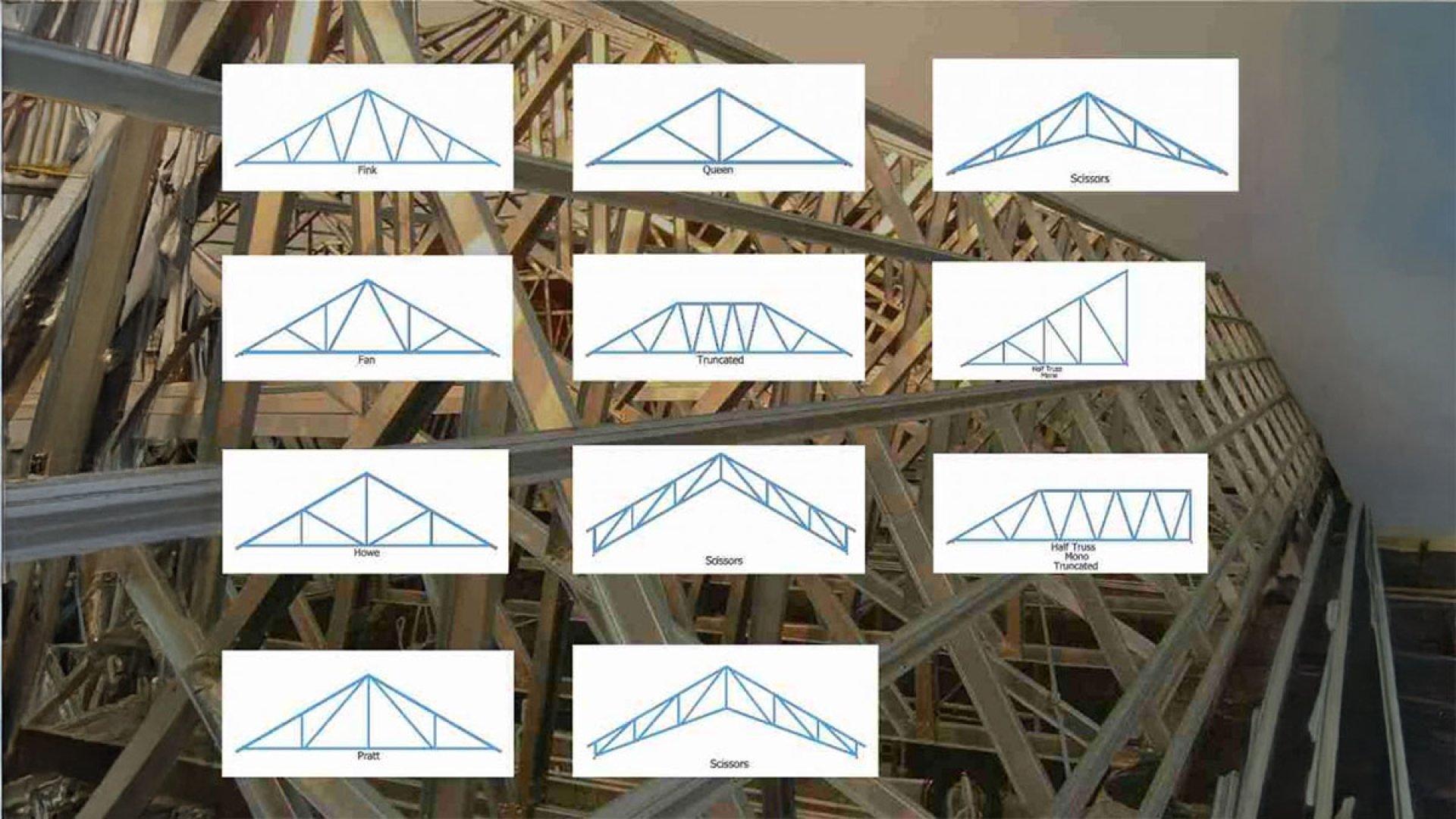
Various truss configurations are commonly used in lightweight steel roof structures, including the following types:
1. Standard Truss
The standard truss has a triangular shape. However, the arrangement of its web members can vary, resulting in different truss classifications. Each web configuration produces different axial forces, both tension and compression. Selecting the most efficient web member arrangement plays a key role in optimizing material usage and directly affects the overall cost of the structure.
2. Truncated Truss
A truncated truss is a modified version of the standard truss, where the top portion is cut off, creating a horizontal top chord. This configuration is commonly referred to as a Horizontal Top Chord (HTC) truss.
3. Scissors Truss
A scissors truss features an inclined bottom chord. The slope of the bottom chord may match the top chord or differ, depending on the design requirements. Scissors trusses can be supported by either two or four supports.
The number of end supports significantly influences the dominant forces acting on both the top and bottom chords. Support reactions must be carefully considered in the design of the ring beam, as scissors trusses typically generate substantial horizontal forces.
4. Half Truss or Mono Truss
A half truss, also known as a mono truss, forms a right-angled triangular shape and is designed with a single roof slope.
5. Truncated Half Truss or Mono Truncated Truss
This configuration is a truncated version of the half or mono truss, where part of the truss is cut to meet specific architectural or structural requirements.
In addition to the configurations above, other truss variations may be developed as adaptations of these basic forms to accommodate specific roof layouts and design plans.